Reliance’s Solar Revolution: The Kutch Project Leading India’s Energy Shift

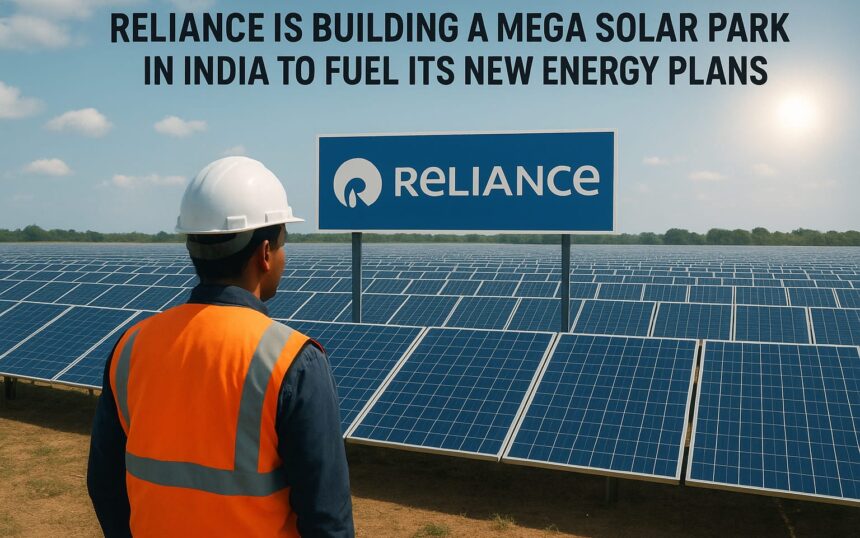
A New Sun Rises: Inside Reliance’s 550,000-Acre Solar Ambition
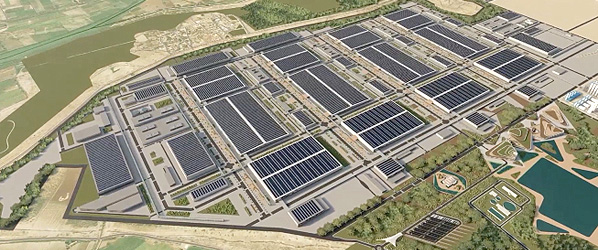
A quiet revolution that could reshape India’s energy future is taking place in the arid region of Kutch, Gujarat. Long linked to gas and oil, Reliance Industries is making a strong shift to renewable energy. It will cover about 550,000 acres of arid land — roughly three times the area of Singapore.
This solar park is part of a broader vision to create a fully integrated renewable energy ecosystem—one that includes:
- Solar PV manufacturing
- Battery energy storage systems (BESS)
- Electrolyser production
- Green hydrogen and fuel cell technology
And it’s all being anchored in Gujarat’s Green Energy Giga Complex, a sprawling facility in Jamnagar that will support the production and deployment of clean energy technologies at scale.
Khavda Solar Park/Gujarat Hybrid Energy Park
For decades, Reliance Industries symbolized India’s dominance in fossil fuels. But global energy dynamics are shifting, and so is the company. Chairman Mukesh Ambani has committed to achieving net-zero carbon emissions by 2035, placing green energy at the core of Reliance’s next growth phase.
🚀 Introduction — Framing Reliance’s energy pivot.
📍 Location & Scale — The Kutch solar park and its sheer size.
⚙️ Tech & Infrastructure — Solar modules, BESS, electrolyser plans.
💡 Vision — Green hydrogen, domestic manufacturing, energy security.
⚠️ Challenges — Land use, grid readiness, capital cost, etc.
🔮 Future Outlook — How this reshapes India’s energy landscape.
Goals:
- To meet nearly 10% of India’s electricity needs within the next decade through this project.
- To scale green hydrogen capacity to 3 million tonnes per annum equivalent by 2032.
- To build large‑scale battery and electrolyser gigafactories: battery factory starting with 40 GWh/year, scaling to 100 GWh/year; electrolyser capacity ~3 GW/year.
Current Progress / Status :
- The Jamnagar facility has started producing HJT modules (~200 MW already) with plans to scale to ~10 GW in the near term.
- Battery and electrolyser giga‑factories are under construction; expected to be operational around end of 2026.
- Reliance has commissioned its solar PV manufacturing chain pieces; module manufacturing, production of panels etc.
- Infrastructure around ports (Jamnagar, Kandla) for marine/land connectivity is being aligned to enable transmission, production, export.
Challenges & What Needs Close Keeping :
Even with its size and ambition, several risks and challenges remain. These are critical:
| Area | Key Issues / What to Monitor |
|---|---|
| Land & Environment | Acquiring 5,50,000 acres of arid land may seem easier than fertile land, but ecological concerns remain (flora, fauna, habitat disruption, dust, soil erosion, microclimate effects). Also, who owns the land, whether there are legal, tribal or usage rights to consider. |
| Water & Resources | Even solar manufacturing, cleaning panels, cooling etc., need water. In arid regions, water is scarce. Logistics (roads, grid access) are major challenges. |
| Transmission & Grid Integration | Generating power is one thing; evacuating it reliably across distances to demand centres is another. Grid congestion, losses, infrastructure delays, permitting, environmental clearances are all possible bottlenecks. |
| Storage & Intermittency | Batteries degrade; cost remains substantial. Solar works only when sun shines. Ensuring enough storage capacity and backup is critical. Also efficient scheduling of battery usage. |
| Costs & Financing | Capex is massive. Reliance will need to manage cost overruns, supply chain disruptions (materials, components), inflation in labor, transport. Funding sources, partnerships, subsidies, tariffs etc. matter. |
| Technology Risk | While HJT is promising, scaling it well, ensuring long lifespan, maintenance, module efficiency under harsh conditions (heat, dust, sand) is non‑trivial. Electrolysers, green hydrogen tech also still under improvement. |
| Policy / Regulatory Support | Stable policies for solar / hydrogen / renewable energy over long term, clear incentives/subsidies, power purchase agreements (PPAs), export regulations, international trade rules etc. |
| Labor & Social Impact | Ensuring that local communities are engaged, jobs are created, labor rights are protected, displacement (if any) is addressed, compensation, amenities etc. Also managing expectations. |
| Demand and Market for Green Fuels | Producing green hydrogen, ammonia, methanol is only useful if there is validated demand domestically/internationally, favourable pricing, supply‑chain (liquid/gas transport, storage), regulatory acceptance. |